Every developer knows the sinking feeling of receiving an emergency message: "Users aren't receiving password reset links" or "Our checkout invoices stopped sending." You investigate, only to discover that your daily SMTP sending quota on Gmail or Zoho was quietly exhausted at 3:00 PM, or your third-party SaaS email bill spiked into hundreds of dollars simply because your user base grew.
.env files, suffer from arbitrary daily provider limits (100–500 emails/day), face catastrophic single-point-of-failure outages when an SMTP node times out, and pay extortionate monthly subscriptions to services like SendGrid or Postmark.The 4 Major Developer Headaches with Transactional Email
When launching web platforms, mobile backends, SaaS tools, and client portals, teams encounter identical roadblocks:
- 1. The Daily Provider Quota Wall: Standard business email providers impose hard daily sending thresholds (e.g., Google Workspace: 2,000/day, free Gmail: 500/day, Zoho free/starter: 250–500/day, Brevo free: 300/day). Once your app crosses this limit, all subsequent outgoing emails fail silently or bounce.
- 2. Configuration &
.envSprawl: When managing 10 to 20 client applications or microservices, raw SMTP credentials (host, port, username, password) are duplicated across dozens of servers. If an email password rotates or an IP address changes, you must SSH into every machine, manually update configuration files, and redeploy services. - 3. Cost Escalation with Commercial APIs: As email volume climbs from thousands to tens of thousands, commercial email APIs (Mailgun, SendGrid, Amazon SES) charge steep monthly retainers and overage fees that punish growing projects.
- 4. Single Point of Failure (SPOF): If your primary SMTP server encounters DNS propagation latency, socket timeouts, or temporary rate limiting, your entire application workflow halts. Without complex fallback code written into every app, messages are permanently lost.
Enter gSend: The "Cascade & Cycle" SMTP Engine
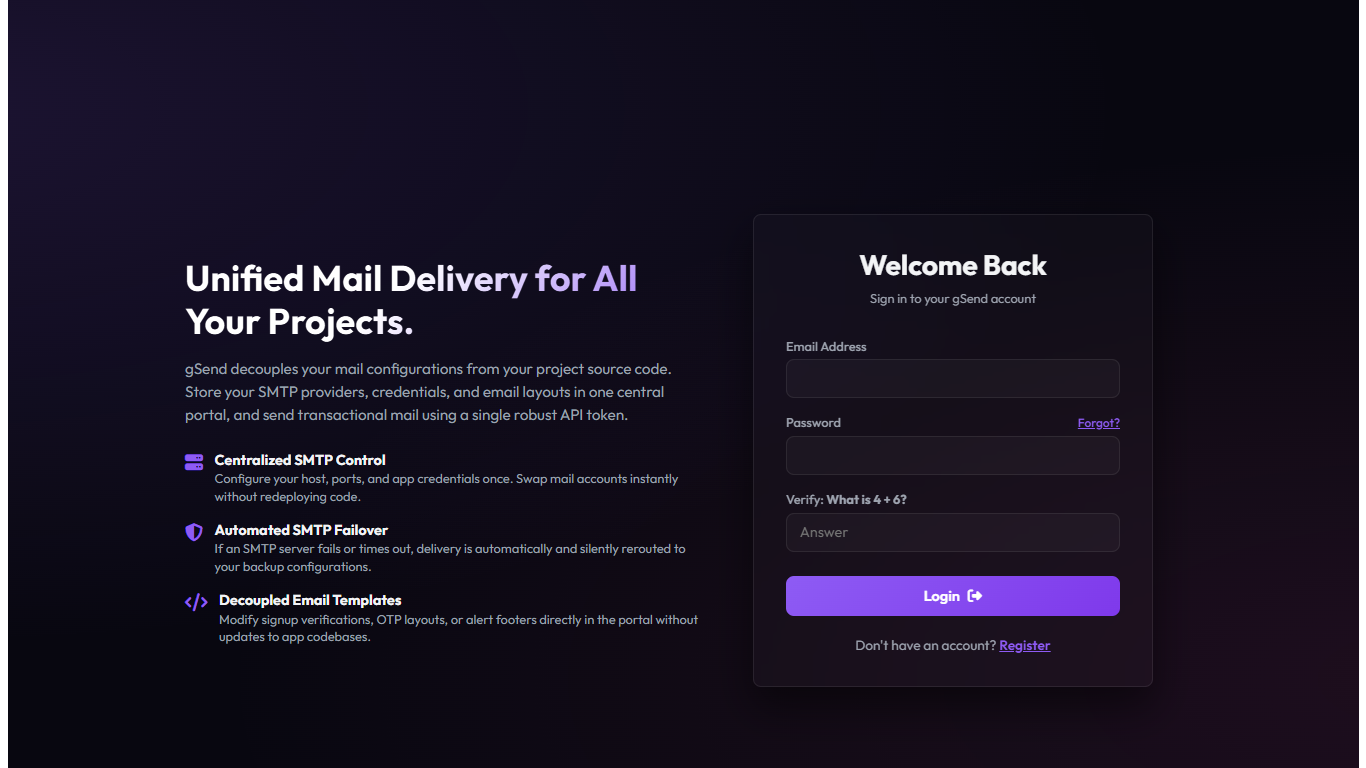
gSend was engineered by Glofora to solve this exact problem: an intelligent, decoupled SMTP gateway that pools multiple free and standard SMTP accounts together, dynamically routing traffic with automated cascading failovers and zero monthly fees.
How SMTP Pooling & Automatic Cascading Works
Instead of hardcoding a single SMTP server into your app, you connect all your available SMTP accounts inside gSend's central control plane (e.g., Google Workspace, Zoho Mail, Hostinger VPS, AWS SES, or custom Postfix servers). gSend then operates as an intelligent round-robin cascade engine:
- Priority-Ranked Routing: gSend dispatches your application's emails through SMTP Server #1 by default.
- Autonomous Limit & Timeout Detection: The moment SMTP #1 reaches its daily cap (e.g., 500 emails) or returns a
421 Too Many Connections/ socket error, gSend intercepts the event in milliseconds. - Instant Cascade Failover: Without your application ever noticing, gSend automatically routes the very next email through SMTP Server #2, then SMTP Server #3, and so on. Your end users never experience dropped OTPs or delayed checkout invoices.
- Daily Automatic Quota Reset: At midnight (00:00 UTC), gSend's internal scheduler automatically re-audits the sending pool, resets provider quota counters, and restores SMTP #1 to primary status for the new day.

One Unified REST API Across All Your Projects
With gSend, you never need to configure SMTP libraries (like PHPMailer, Nodemailer, SwiftMailer, or Python smtplib) in any of your applications again. You replace verbose, fragile socket code with a single, ultra-clean REST API call:
// Example: Dispatching an email via gSend REST API
const response = await fetch("https://gsend.glofora.com/api/v1/send", {
  method: "POST",
  headers: {
    "Content-Type": "application/json",
    "Authorization": "Bearer YOUR_GSEND_API_KEY"
  },
  body: JSON.stringify({
    to: "client@example.com",
    subject: "Your Account Invoice #1042",
    html: "<p>Thank you for your business!</p>",
    tag: "billing_notification"
  })
});

const result = await response.json();
// Output: { status: "queued", dispatched_via: "smtp_server_02", message_id: "gs_9x81..." }
Notice the massive architectural benefit: your application doesn't know or care which physical SMTP server is executing the transmission. If a provider goes down or you swap out a corporate domain, you simply update your credentials once in gSend. Every single one of your production applications adapts instantly without touching a single line of code.
Decoupling HTML Templates from Codebase
A secondary nightmare for developers is updating transactional HTML email designs. Every minor change — whether fixing a logo URL, tweaking a promotional banner, or adjusting footer compliance links — requires a developer to open the repository, modify Blade or JSX templates, commit to Git, run CI/CD tests, and redeploy.
gSend decouples templates from code. Product managers and marketers can visually customize responsive HTML templates directly inside gSend's dashboard using dynamic merge variables (e.g., {{user_name}}, {{reset_link}}, {{invoice_amount}}). Developers simply invoke the template by its unique identifier (template_id: "welcome_onboarding"), ensuring clean code separation.
Enterprise Security & Deliverability Protection
Pooling SMTP accounts without security oversight can endanger sender reputation. gSend enforces rigorous guardrails:
- SPF, DKIM, and DMARC Alignment: Built-in DNS verification audits ensure that outgoing servers are properly authenticated on behalf of your sender domains, preventing spam-folder degradation.
- Per-App API Tokens & Rate Limiting: Create isolated API keys for different environments (Production, Staging, QA) with customizable hourly velocity thresholds to stop rogue scripts or compromised forms from draining quotas.
- Dead Letter Queue (DLQ): If every configured SMTP server in the pool fails simultaneously during an upstream ISP blackout, gSend safely buffers outgoing messages in an encrypted Redis queue and retries transmission with exponential backoff once connectivity is restored.
Summary: The Smart Developer's Email Engine
Stop overpaying for commercial email tiers and stop stressing over single-provider daily sending caps. By deploying gSend as your centralized SMTP gateway, you achieve:
- Zero Outages: Continuous cascading failover ensures 99.9% delivery uptime.
- Zero Monthly Fees: Pool free and standard SMTP quotas to unlock enterprise volume without subscription costs.
- Zero Maintenance Overhead: Update email credentials and HTML templates in one central dashboard without redeploying code.